
What a caregiver contract can do
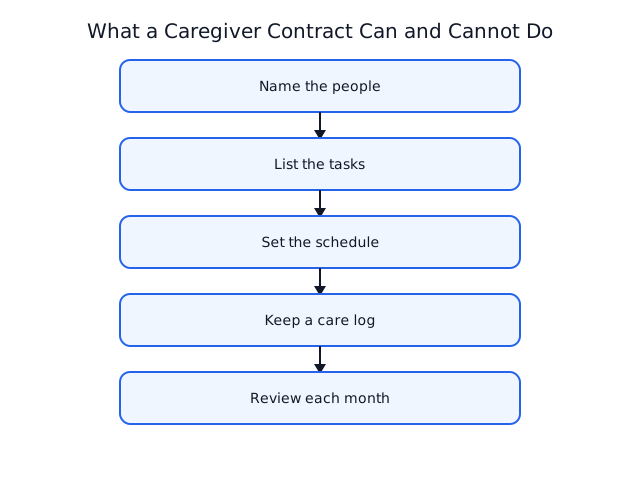
A good agreement can name the people in the plan. It can say who receives care and who gives care. It can also name a backup person for sick days or trips. That one step prevents a common problem: everyone thought someone else was in charge. When names are clear, calls get made faster and visits are less likely to be missed.
It can describe tasks in plain words. Tasks may include meals, bathing help, rides, house work, laundry, shopping, and sitting with the person so another family member can rest. It can say which tasks are not included. Clear limits protect the caregiver from being asked to do work that needs training, such as care that a nurse or therapist should do.
It can set a schedule. The schedule can list days, start times, and end times in words that fit the family routine. It can also say how changes are handled. For example, the family can agree that changes are shared by phone the day before when possible. A simple rule like that cuts stress and helps the person who needs care feel safe.
Sample situation
James O'Connell is in his early eighties and wants to stay in his own home, but he now needs daily help with meals, bathing, laundry, and rides. His daughter, Nora, has quietly taken on most of that work, and her brother, Sean, worries the help will not last if nothing is written down and Nora wears herself out.
Before any payment begins, the family sits down for a calm talk about care needs first, not money. James says what help feels welcome and what feels like too much. Nora says what she can do well and what she cannot do, and Sean agrees to be the backup person for sick days and trips. Together they draft an agreement in plain words that names the people, lists the tasks, sets the days and place of care, and says how changes will be agreed and written down.
Nora starts a simple care log from the first day, noting the date, the tasks done, and any problem that comes up. Because benefits are part of their picture, the family gets local advice before signing, then signs and dates the paper and keeps a copy for each person. Like the guide advises, they plan to review the agreement and the log each month, so the paper matches the care really happening at home.
What a caregiver contract cannot do
An agreement cannot promise that a public program will accept it or treat past care in a set way. Programs have their own rules and their own review. Staff who review a case look at facts, dates, records, and the rules that apply at that time. A family paper is only one part of that picture. It is not a promise of a result.
It cannot replace legal, tax, or benefits advice. Each family has a different mix of health, housing, work, and family ties. A form found online cannot see those details. A short talk with a qualified local adviser can flag risks that a general guide cannot. That step matters most when a home, shared accounts, or care for a spouse or parent is part of the picture.
It cannot make unsafe care safe. If a task needs skill, strength, or training the caregiver does not have, the answer is to change the plan, not to sign a paper. It also cannot force a person to accept care. The person who needs care keeps the right to speak, to ask questions, and to refuse help that feels wrong.
The Medicaid look-back caution, in plain words
Families often hear about a look-back when they ask about Medicaid and long term care. In plain words, it means a program may review past moves of money or property when a person applies. The review reaches back 60 months — five years — from the date the person applies for Medicaid long-term care. The point of the review is to see if assets were given away or moved for less than fair value during that time.
The rate matters too. Payments under a caregiver agreement count as pay for services, not as gifts, only when the rate is at or below fair market value. Fair market value means about what a home care aide or agency charges for the same work in your area. Any amount paid above that value can be treated as a gift and counted in the look-back. The agreement should name the tasks, the hours, and the rate. Pay should track care as it is given, with regular payments and a care log, not one lump sum for years of future care.
This is why timing and records matter. Care that was given with no written plan and no records can be hard to explain later. A reviewer may see a payment between family members and ask what it was for. Notes, calendars, and a signed agreement made at the time can help show that care was real and that the work matched the plan. They do not guarantee how a case will be decided.
Do not try to fix the past by writing a paper that claims care happened in a way it did not. Backdating or guessing is risky and can harm trust in the whole case. This is the same rule stated earlier in this guide: for Medicaid, only care given after the agreement is signed counts as paid care. If past care is unclear, write down what you know now, mark what is uncertain, and get advice before you file or sign anything. You can also read about support programs on the page about checking Medicare Savings Programs and Extra Help, which explains how to check programs through official routes.
Paying the caregiver: the tax side
Paying a caregiver has a tax side many families miss. Under IRS rules, paying a caregiver usually makes the family a household employer. If the caregiver is paid $3,000 or more in cash wages in 2026, Social Security and Medicare taxes apply, and both the family and the caregiver pay a share. Federal unemployment tax applies when pay reaches $1,000 or more in any one quarter. The family reports these taxes on Schedule H and gives the caregiver a W-2. Pay to a spouse, a child under 21, or a parent is generally exempt from these taxes. An adult child caring for a parent is not exempt. IRS Publication 926 explains the full rules. Do not assume the caregiver is an independent contractor. The IRS test is control: if the family controls what work is done and how it is done, the caregiver is an employee.
How to write an agreement that holds up
Start with a calm family talk. Keep the talk short and focused. Name the care needs first, not the money. Ask the person who needs care what help feels welcome and what help feels too much. Ask the caregiver what they can do well and what they cannot do. Write down both answers, even when they do not match yet.
Then draft the agreement in plain language. Use short sentences. Name the tasks, the days, and the place of care. Say how records will be kept. Say how either side can pause or end the agreement. Say how changes will be agreed and written down. Each person should read the full draft alone before signing, with time to think.
Sign and date the paper only when it says what really will happen. Keep a copy for each person who signed. Store it with other key papers, and tell one trusted person where it is. If care needs change in a big way, write a new version instead of scribbling on the old one. A clean new version is easier for everyone to follow.
Records to keep from the first day
Keep a simple care log. Each entry can note the date, the time in and out in plain terms, the tasks done, and any problem that came up. A notebook works. A shared phone note works too. The best system is the one the caregiver will use every time, not the most fancy one. Short, honest notes beat long notes written weeks later from memory.
Keep related papers together. Save visit notes, care plans, receipts for supplies bought for care, and messages about schedule changes. If a bill or notice arrives, the guide on comparing a Medicare Summary Notice with a home health bill shows how to line papers up side by side before you call anyone. That habit helps with any kind of review, not just bills.
Review the log each month as a family. Look for tasks that take longer than planned. Look for care needs that have grown. Look for caregiver strain. A monthly review turns small problems into small fixes. It also keeps the written agreement honest, because the paper should match the care that is really happening in the home.
Common mistakes families can avoid
One common mistake is a vague task list. Words like help out or be there do not guide anyone. Name the task, the time, and the place. Another mistake is a plan built on hope. If the caregiver works, cares for kids, or lives far away, the plan must fit that real life. A plan that only works on a perfect week will fail on a normal week.
A second mistake is leaving out the person who needs care. That person may worry that a contract makes love feel like business. Name that fear out loud. Say that the paper is there to protect everyone and to keep care steady. Many older adults feel better once they see that the paper also limits tasks and sets rest time for the caregiver.
A third mistake is waiting for a crisis. Agreements written in a hospital hallway are rushed and often unclear. If you see care needs growing, start the talk now while choices are wider. Early talks also leave time to check program rules and to ask a local adviser about the look-back and other rules that may apply to your state.
What belongs in the agreement and what belongs elsewhere
The table below sorts common items into two groups: what the agreement itself should hold, and what should be checked through another route. In short, the agreement holds the care plan, while rules and approvals come from programs and qualified advisers.
As the table shows, the agreement is strong for tasks, names, schedules, and records, and it is not the place to settle program, legal, or tax questions. Keep those checks separate and write down what you learn.
- Topic: Care tasks and schedule; In the agreement: Yes, in plain words; Check elsewhere: Ask a clinician if a task needs training
- Topic: Names and backup help; In the agreement: Yes; Check elsewhere: Tell one trusted person where the paper is kept
- Topic: Daily care log; In the agreement: Yes, how it will be kept; Check elsewhere: Keep bills and notices with the log
- Topic: Program approval; In the agreement: No, it cannot promise this; Check elsewhere: Ask the program or a qualified adviser
- Topic: Legal and tax effects; In the agreement: No; Check elsewhere: Get local legal and tax advice
Diagram
What to do next
- [ ] Hold a calm family talk about care needs first
- [ ] Name the caregiver, the person receiving care, and a backup
- [ ] List tasks, days, and place of care in plain words
- [ ] Write how records will be kept from the first day
- [ ] Get local advice before signing if benefits or a home are involved
- [ ] Sign, date, copy, and store the agreement where a trusted person can find it
- [ ] Review the agreement and the care log each month
Coverage & payment at a glance
Payment depends on the service, eligibility, location, and the individual plan. Confirm benefits before arranging care.
Medicare
Payment depends on the exact covered medical service; Medicare does not pay most long-term custodial care.
Medicaid
May pay eligible medical care, nursing-facility care, or community services under state rules.
Private pay
Pays the amount left after benefits and any service that is not covered.
Sources & review status
Source and independent editorial checks completed. Licensed professional review is not claimed.
This guide provides general education. It does not establish an individual’s eligibility or replace advice from a qualified professional. Sources checked on 2026-10-28.
- Transfer of Assets in the Medicaid Program — Deficit Reduction Act backgrounderCenters for Medicare & Medicaid Services (CMS / HHS) · Accessed 2026-10-28
- Publication 926 (2026) — Household Employer's Tax GuideInternal Revenue Service (IRS) · Accessed 2026-10-28
- Using a Caregiver Contract — New York Medicaid caregiver agreement ruleNew York State Medicaid rule documentation (SSL §366(5)(e) / 18 NYCRR 360-4.4(c)) · Accessed 2026-10-28
- Caregiver Agreements in New Jersey — Medicaid requirementsNew Jersey Medicaid caregiver-agreement requirements (as documented) · Accessed 2026-10-28
Community discussion
Questions and experiences
Comments are public and reviewed before they appear. Keep names, medical records, and contact details private. Comments are readers’ views, not verified care advice.
No approved comments yet. You can start the conversation.